|
|
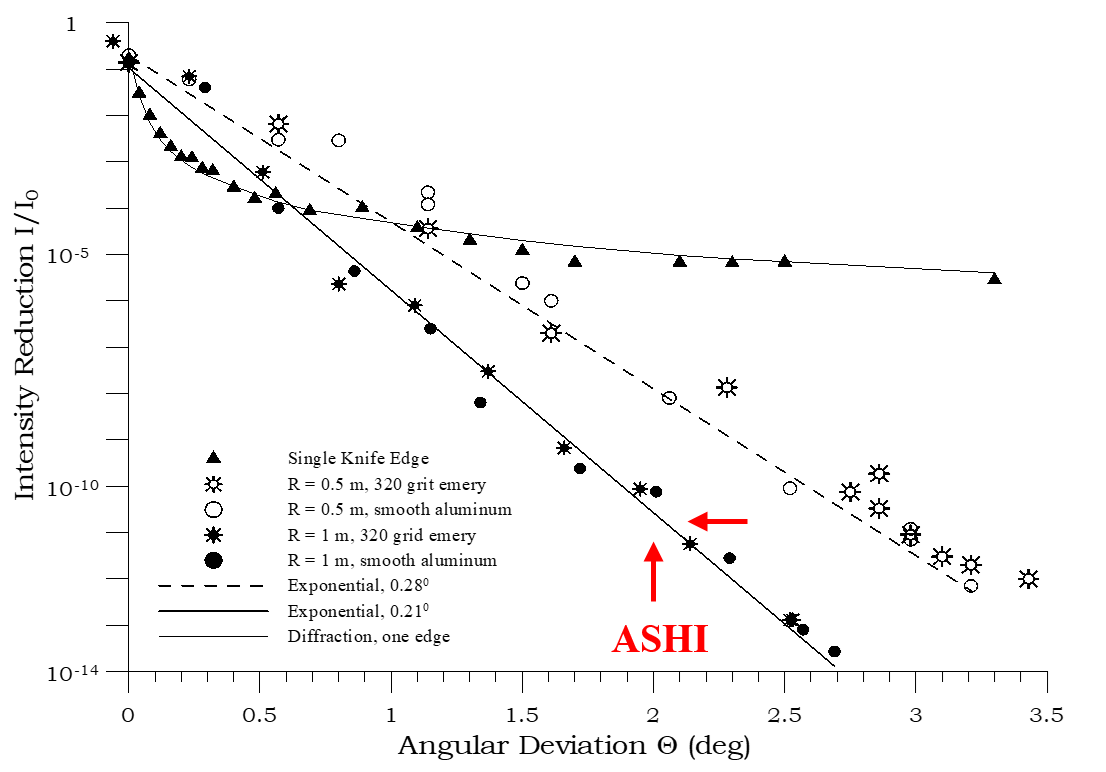
The above image shows laboratory measurements of the reduction of stray light. The corral is illuminated from below the ASHI field of regard. Two corrals, one (R=0.5m) more curved than the other (R=1.0m) which contain both rough and smooth surfaces, are compared with the diffraction of a single knife edge. The corral provides a very dark umbral region for full quality performance when slightly more than a hemisphere is free of background-light sources (including bright illuminated spacecraft apendages). Performance of the baffle is insensitive to even several tenths of a degree misalignment of the corral-and-optical-system axis relative to the Sun and other bright objects. Performance is also insensitive to the curved baffle's surface color, smoothness, and potential contamination. In tests, 320-grit sandpaper was attached to the curved 2 degree baffle and was proved as effective as a smooth surface in reducing stray light.


|
(Left) The detector mapping is derived using 23 identified stellar signals. Incident angle is measured relative to the center of the FOV in the sky, and the camera chip distance is the resulting displacement relative to the center of the detector. The blue line represents incident angle versus chip distance. The red line displays incident angle versus camera response based on a uniform source traveling across the image plane. Vignetting from the corral produces sharp fall-offs for the direct view of the lens (main curve) and for the view reflected in the two small, flat mirrors (far right-hand segment). (Right) The figure indicates the measured stray light performance of the fisheye lens. Stray light reduction of a combined value of greater than 10^-15, adequately provides a view of background solar wind structures at greater than 90 degrees from the Sun.

The image above details the vignetting of the mirror and lens. From tracking the star Vega into the mirror and subsequently the lens the analog-to-digital unit (ADU) is retrieved and plotted for any value above the background of the night sky (~70,000 ADUs). The red line plots the exposures from the mirror where Vega is closest to 90 degrees from the central axis. The first few tenths of a degree exemplify the vignetting of a star rising up over the corral. Then the lens view (blue line) picks up where the mirror begins to fall off creating a near continous view of Vega.